Editorial responsibility for this article rests with Wuhan Ooi Photoelectric Technology Co., Ltd. Written and reviewed by the Ooitech editorial team. See our editorial policy for how we write, where AI tools are used, and how to request a correction.
TAC vs BC: What the Name Decides and What Your Line Builds
Table of Contents
Quick answer: TAC and BC answer two different questions, which is why one product can carry both names honestly. TAC — TOPCon-based amorphous-silicon passivating cell — names the platform: which materials passivate the surfaces and how carriers are collected. BC names the architecture: both polarities and their metal sit on the rear, with no front grid. Jinko’s own materials use both, describing its 17 October all-black residential module as a TAC platform on a back-contact structure. For a module line the label is not the actionable part: what changes tooling is whether both polarities are on the rear, whether a front grid exists, and therefore whether the joint is made on the rear face. A structural description of that kind cannot settle cost, mass-production maturity or patent ownership, and the company did not claim that it does.
“Is it BC?” and “is it better?” sound like the same question and are not. One is about where the metal sits. The other is about what happens inside the silicon. A vendor answer to the second can look like an answer to the first, which is how a naming clarification becomes a technical argument it was never meant to settle.
Two axes, one word each
Back-contact is a layout statement. Put both polarities on the rear and remove the front grid, and you have bought optical area at the cost of a harder process; nothing in that sentence says which materials do the passivating or how the carrier selectivity is achieved. Those are platform decisions, and platforms are where most of the last decade of cell development actually happened.
That is why a single product can be described correctly in two vocabularies at once, and why arguments that treat the two words as competitors tend to go nowhere. A cell is not “BC or TOPCon” any more than a house is “steel or two-storey”.
What Jinko said, and what it deliberately did not
On 23 October Jinko published a clarification of the distinction, and four points in it are worth keeping separate from the commentary around them.
| Point in the company’s statement | How to read it |
|---|---|
| TAC is a cell technology platform; BC mainly describes an electrode layout. The two are not concepts at the same level. | This is a definitional claim, not a performance claim. It is the part that is easy to verify and hard to argue with. |
| TAC can, in principle, adopt different electrode layouts depending on application. | A platform is extensible. It says what the company could build later, not what the released product is. |
| The all-black residential module released on 17 October is described on the company’s own site as using core back-contact technology, with no front metal grid. | This is a claim about an existing product, and it is checkable against the product’s published structure. |
| The structural reading does not address manufacturing cost, mass-production maturity or patent ownership. | The boundary matters. A naming clarification is not evidence about yield, price or IP, and the company did not present it as such. |
Summary of Jinko’s 23 October statement as reported; quotations are the company’s own wording as translated, not ours.
The last row is the one most commentary skipped. If a structural description could settle questions about cost and IP, cell engineering would be a much easier job than it is.
Where TAC sits on the ladder we already published
We sorted the back-contact vocabulary once before — IBC, TBC, HBC and HIBC — in the BC cell technology roadmap from structure to process. Those names classify by architecture and by which contact system is used, which is why they line up on one ladder. TAC does not belong on that ladder at all. It sits on the other axis:
| Layer | The question it answers | Names that belong here |
|---|---|---|
| Platform (materials, passivation, carrier selectivity, thermal budget) | What makes the contacts selective, and at what process temperature? | TOPCon, SHJ/HJT, and hybrid stacks such as TAC |
| Architecture (electrode layout) | Where do both polarities and the metal sit? | Front-and-back contact, IBC/all-back-contact, and the TBC, HBC, HIBC combinations |
| Product (what ships) | Which platform and which layout are in this module? | The 17 October all-black residential module, for example: TAC platform, back-contact structure |
Our framing, built on the definitions in the source statement. The acronym ladder itself is covered in the roadmap article linked above.
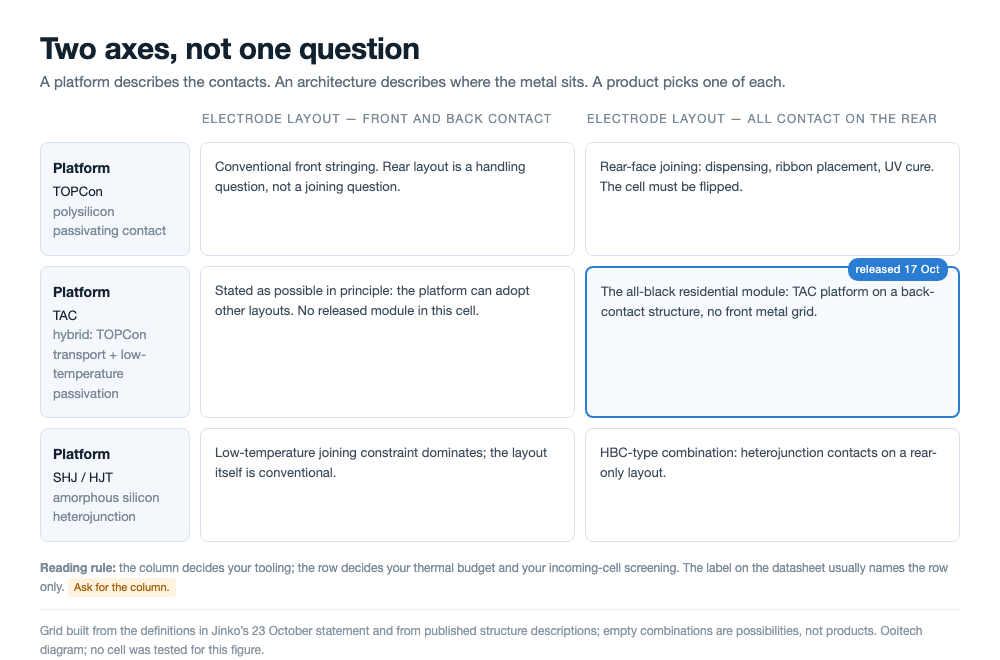
Figure: the two axes, with the released product placed on both. The column decides your tooling; the row decides the thermal budget and the incoming-cell screening. Empty combinations are possibilities, not products.
Once the axes are separate, the extension logic the company described becomes ordinary rather than confusing. A platform that is defined by its contact materials can be paired with more than one layout. If a future variant were to place the two polarities on opposite faces, the classification would change; the platform would not. That is a statement about optionality, and it leaves the released product exactly where it was.
What the acronym actually contains
The acronym is a description. TAC reads as TOPCon-based amorphous-silicon passivating cell: T is the contact system it keeps, an ultrathin oxide under doped poly-Si; A is what it adds on the emitter side, an intrinsic and doped a-Si:H stack that drops surface recombination far enough to buy open-circuit voltage; C is the noun. The company shorthand is 2+1: two contact technologies, one layout change.
| Region | What sits there | What it does | What the step implies |
|---|---|---|---|
| Front face | SiNxOy and AlOx passivation, no metal | passivation and antireflection | fired before either rear contact |
| N region, rear | SiOx tunnel oxide, n+ poly-Si, TCO | tunnelling transport, minority carriers blocked | a high-temperature poly-Si step |
| P region, rear | a-Si:H(i), a-Si:H(p), TCO | emitter passivation, the Voc side of the gain | below 200 C, and every later step inherits that ceiling |
| Between them | laser-patterned isolation plus a dielectric film | keeps the polarities apart on one face | after both contacts exist |
Stack description follows the platform diagram published with the Tiger Neo 5.0 materials, via Chinese-language technical reporting in late October 2026; we have not obtained the white paper. The right-hand column states what each step requires, not a measured window.
The column to carry into a line meeting is the last one. A stack with one hot and one cool contact carries two ceilings, and the lower governs everything after it. Here the a-Si:H side sets it, so metallization and the joint are capped by a number the cell vendor chose before your machine was specified. That is what low-temperature compatibility means in practice, and why this cell cannot be joined like a plain TOPCon cell.
When encapsulating cells with sensitive amorphous layers, we tune the heating plates and chamber vacuum times to prevent overheating the rear contacts while ensuring full curing across the glass stack.
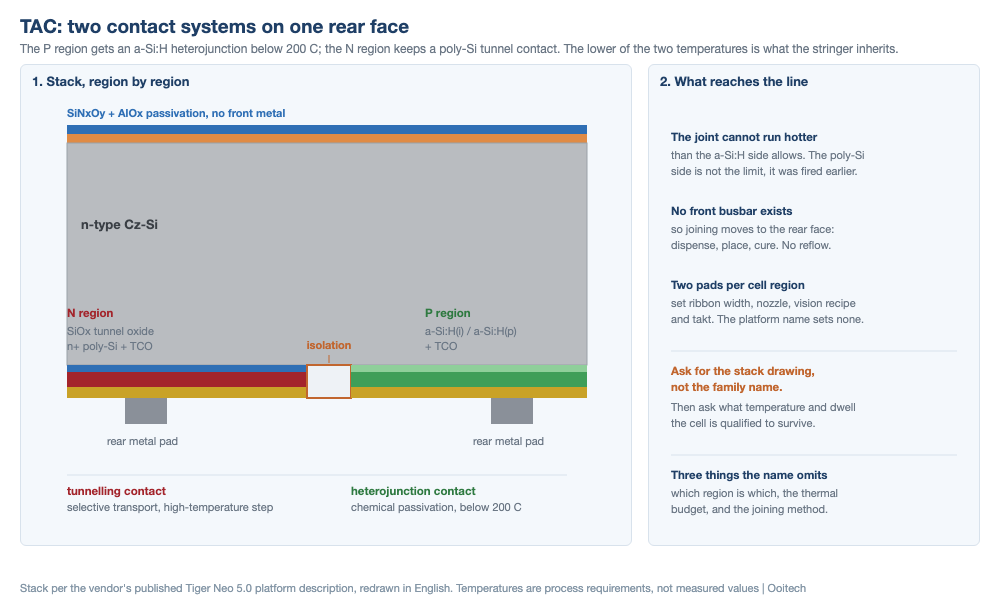
Figure: two contact systems on one rear face. The poly-Si side was fired hot before the amorphous side existed; once the a-Si:H stack is down, every later step including the joint stays under its ceiling.
The released product, in numbers: an all-black 48-cell residential module announced on 17 October, up to 510 W and 25.52 percent module efficiency, about 30 W above a conventional back-contact module of the same size, on a platform the company credits with 28 percent cell efficiency. Vendor figures, on a product we have not measured. The actionable part: the same configuration now ships under at least four names, Jinko TAC, LONGi HIBC, Trina THBC and JA HBC, each handing the p-side emitter to low-temperature amorphous silicon and leaving the n-side back field to poly-Si, as covered in the LONGi HIBC record and the THBC structure. The names differ. The two-temperature problem does not.
The three questions that actually change tooling
This is the part that matters if you are buying or rebuilding a line, because none of it depends on which name a marketing department prefers.
| Question | If the answer is yes | What it does to the line |
|---|---|---|
| Are both polarities contacted on the rear? | No front grid exists to solder to | The cell runs rear-side up. Joining becomes adhesive dispensing, ribbon placement and UV cure on the rear face; flipping and low-stress handling enter the flow |
| Is there any front-side metal? | There is something to solder conventionally | Classic front stringing still applies, and the rear layout is a handling question rather than a joining question |
| What pad pitch and adhesive spec does the rear use? | The joint geometry is fixed by the cell, not by the machine | Ribbon width, dispense nozzle choice, vision recipe and takt all follow from it — and so does your rework strategy, because a cured UV joint cannot be unsoldered |
Consequences for module assembly; the cell-side implications of rear-only contact are covered in the roadmap article and in our note on where 0BB gains and yield limits sit.
Note what is not in that table: the passivation stack. Whether the selectivity comes from polysilicon, amorphous silicon or a hybrid of the two does not by itself decide how you join the cell. It does change something else, quietly: the thermal budget the cell tolerates, and therefore how much heat your joining step is allowed to apply.
For modules with tighter thermal limits, we configure our laminators with multi-stage heating profiles and controlled membrane pressure so the encapsulant flows without exceeding the safe temperature ceiling of the rear passivation.
That is the second-order effect worth flagging to your process team. A stack assembled from a high-temperature contact and a low-temperature one inherits both budgets at once — which is exactly the tension described in our comparison of the two back sides and in the wider comparison of the four cell families.
Where the hybrid stack gets hard inside the cell
The technical substance behind a hybrid platform is not the name. It is that a single rear face has to host two contact systems with different material physics. A March 2026 paper in Nature demonstrated the combination — an electron-selective contact derived from TOPCon, a hole-selective contact derived from silicon heterojunction, and a back-contact layout — and studied carrier collection and interface loss.
Read that as a feasibility demonstration, which is what the source calls it, and not as a process report for any commercial product. The manufacturing constraints it points to are the ones that decide whether such a cell ramps:
| Constraint | Why it bites |
|---|---|
| Area isolation between the two polarities on one face | The regions sit side by side; a patterning error is a leakage path, not a cosmetic defect |
| Interface recombination at both contacts | Two passivation systems have to work in the same thermal history, and one of them is sensitive to the other’s temperature |
| Current transport to the rear pads | Reducing recombination is only half the job; carriers still have to arrive |
| Contact resistance against the optical gain | A resistive contact can consume the current that removing the front grid was supposed to add |
Constraints as summarised in the source; the underlying study is a feasibility paper, not a production report.
One more consequence deserves saying plainly: two cells can both be BC and still differ in contact material, process order and metallisation. Those differences are invisible in the name and visible in your incoming inspection. It is the same reason we argue that the BC module process should be specified per cell supplier rather than per technology label.
What we ask a cell vendor before quoting a stringer
Five questions, in the order we ask them. None of them mentions a marketing name.
1. Send the electrode cross-section drawing, including which face each polarity contacts. 2. Confirm front-side metal: none, or fingers and pads at what pitch? 3. Give the rear pad geometry — size, pitch, keep-out — and the adhesive specification the cell is qualified with. 4. Give the maximum temperature and dwell the cell tolerates at the joint, and for how long. 5. Tell us which incoming-cell parameters you screen, because on a rear-only layout the screening step is doing work the front side used to do.
Ask for those five and you will know more about what your line has to become than any label can tell you. If you are still choosing the platform itself, the station sequence and what each station can compensate for is in how a tabber-stringer works and how to choose one.
A specification that cannot be quoted
The practical cost of mixing the two axes shows up at the quotation stage. An RFQ that names a technology rather than a geometry forces every supplier to guess, and the guesses do not converge.
| Field | Typical RFQ wording | What the machine actually needs |
|---|---|---|
| Technology | “BC” or “TAC” | Electrode layout: which face each polarity contacts |
| Joining method | “0BB” | Adhesive type and channel count, weld method, cure profile |
| Cell format | Wafer size | Wafer size plus rear pad pitch, pad size and keep-out zone |
| Throughput | Modules per day | Cells or half-cells per hour, and the string length the layout implies |
| Yield target | A percentage | Which station the number is measured at, and on which incoming distribution |
Our list, drawn from the questions that change an equipment quotation rather than a project discussion.
The fifth row is where most early conversations stall. A yield target quoted as a single number hides whether the loss is assumed at the joiner, at the flip, or in incoming material — and on a rear-only layout the incoming cell is doing work that a front-contact line used to do with its busbars.
Where these facts come from
The product and naming facts here come from Jinko’s 23 October statement as reported, the company’s own website and product materials, and secondary reporting; the hybrid-contact study is the March 2026 Nature paper on combined selective contacts, described by the source as a feasibility demonstration rather than a process report for a shipped product. The region-level stack description and the 17 October product figures come from Chinese-language technical reporting published in late October 2026 that cites the Tiger Neo 5.0 platform white paper; we have not obtained that white paper, and the layer list should be read as a description of a published platform diagram rather than a process specification. We have not tested, measured or disassembled any cell discussed here, and nothing in this article is a claim about the performance, cost, yield or intellectual-property position of any manufacturer. The two-axis framing, the tooling table and the five questions are ours.
The BC series, in order of what breaks first
· TOPCon to BC retrofit: what changes and what it costs per GW — the budget question, station by station
· The BC family sorted by structure and process — the other axis this article does not cover
· BC stringing warp: both ends curl — what a rear-only layout does to a thin cell in the joiner
· Hybrid-contact BC cells at 28 percent — where the platform and the layout stop being separable
· BC orders booked to 2027 — why the demand side, not the cell name, sets your schedule
Frequently asked questions
Is a TAC cell a type of BC cell?
The released residential module is both: a TAC platform built on a back-contact structure, according to the company’s own description. But the two words classify different things, so “TAC is BC” is only true of a specific product, not of the platform as a definition.
Is TAC just another name for heterojunction?
No, and saying so repeats the same category error in the other direction. TAC is described as TOPCon-based, borrowing heterojunction-related low-temperature processing and emitter-side passivation. Its carrier transport comes from the TOPCon side of the family.
Does a TAC cell need a different stringer?
Not because of the name. It needs a different stringer if, and only if, both polarities are on the rear — then the joint is made on the rear face with dispensing and UV cure instead of on a front busbar. Ask for the electrode layout, not the product family.
How does TAC differ from TBC, HBC and HIBC?
Those three classify architecture-plus-contact combinations and sit on one ladder. TAC classifies the contact platform, which can in principle be paired with more than one layout. Comparing them directly is comparing a column with a row.
Did this settle the BC cost, yield or patent argument?
No, and the company’s statement explicitly leaves those questions untouched. A structural description can establish where the metal sits; it cannot establish what a module costs to build, how mature the line is, or who owns which patent.
Is hybrid back contact proven in mass production?
Not by the paper cited. It demonstrates that stacking an electron-selective contact from one family and a hole-selective contact from another on a single rear face is physically workable, and studies interface loss. Manufacturing evidence is a separate question, and it is the one that decides adoption.
Which side of a hybrid cell limits the joining temperature?
The amorphous-silicon side. A poly-Si contact was formed hot earlier in the flow and does not care about a 200 C joint; an a-Si:H stack does, and every later step stays under its ceiling. That is why these cells are joined with adhesive and cure rather than reflow, and why the qualified temperature and dwell belong in the RFQ ahead of any platform name.
If a supplier says they are going BC, what do I need to know?
Three things: whether both polarities are on the rear, whether any front-side metal remains, and what rear pad geometry and adhesive the cell is qualified with. Those three answers define your joining process; the platform name does not.
Final thoughts
Platform names describe what happens inside the cell; architecture names describe where the metal sits. Both are useful, and neither substitutes for the other. When a supplier introduces a new platform name, the question for your line is unchanged: are both polarities on the rear, and does that force the joint onto the rear face? Answer that, and the label becomes a footnote rather than a specification.
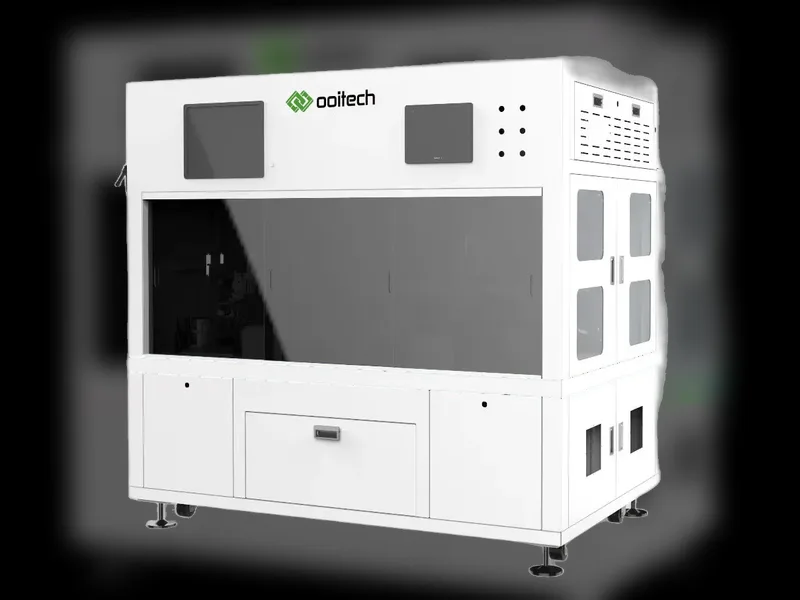
OOITech manufactures single and double chamber solar panel laminator machines with oil-heated or electric platens to maintain uniform thermal control across sensitive cell architectures. If you are developing back-contact or hybrid cell modules, send your drawings, module stack, or sample laminates to our engineering team for cycle evaluation and recipe testing.