Editorial responsibility for this article rests with Wuhan Ooi Photoelectric Technology Co., Ltd. Written and reviewed by the Ooitech editorial team. See our editorial policy for how we write, where AI tools are used, and how to request a correction.
Semi-Flexible Solar Panel Manufacturing Process
Table of Contents
Quick answer: Semi-flexible solar panels are made by replacing the rigid front glass and aluminium frame with a polymer frontsheet and a thin encapsulation stack, so the finished module can bend to a defined radius without cracking the cells. The production route starts the same way as a conventional line — cells are cut and soldered into strings — but the lamination step changes completely, because the frontsheet cannot take the pressure a glass stack can and the encapsulant has to bond to a flexible substrate. Handling through the framing station is removed and the junction-box and edge-sealing steps are adapted to a thinner laminate. The engineering trade-offs are real: a semi-flexible panel gives up some mechanical load rating and some long-term UV margin in exchange for weight and mounting flexibility on curved or weight-limited surfaces such as vehicle roofs and portable arrays.
PV Module Manufacturing · by Jerry, Ooitech
Product Introduction
As photovoltaic technology keeps moving forward, a new kind of PV product has appeared on the production side that is quite different from glass solar modules. It is lighter, more flexible, and far more convenient to use. This is the semi-flexible solar module, often called a semi-flexible panel in the industry.
Semi-flexible PV modules have a wide range of applications. They cover distributed solar power scenarios such as commercial and industrial color-steel tile roofs, flat roofs, residential tile houses, and building-integrated photovoltaics (BIPV). They also fit special scenarios like landscape lighting, portable power sources, robots, and outdoor activities.
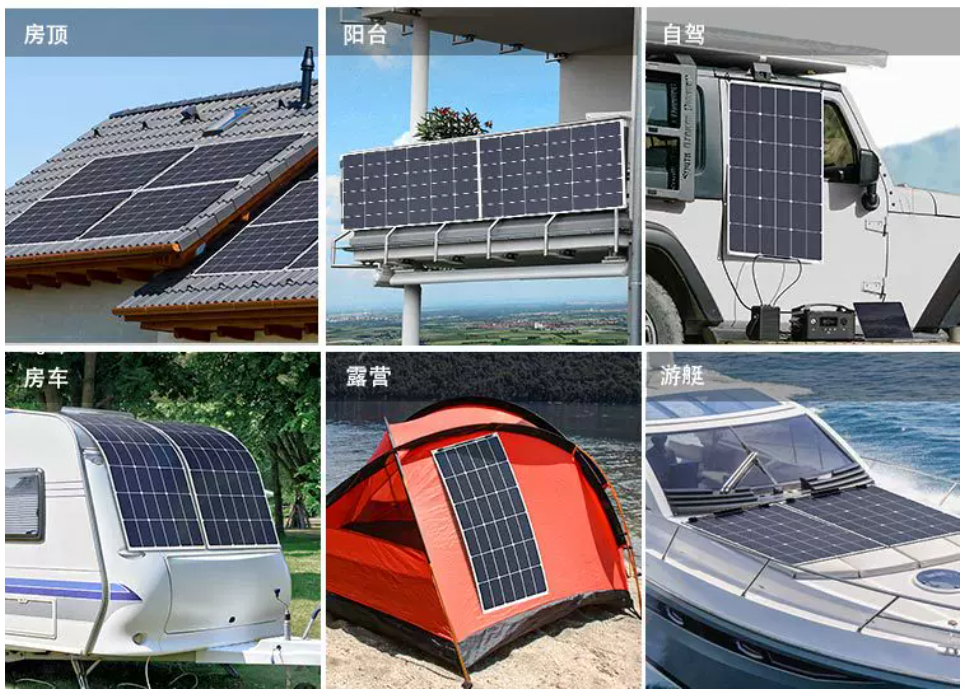
With advantages like softness and flexibility, light weight and portability, good plasticity, high efficiency, and being environmentally friendly, semi-flexible modules are gradually becoming a favorite in the new energy field, winning more and more user trust. Today let's take a simple look at the manufacturing process and structure of flexible PV modules.
Module Structure
Here is a structure diagram and promotional image of a flexible PV module found online:
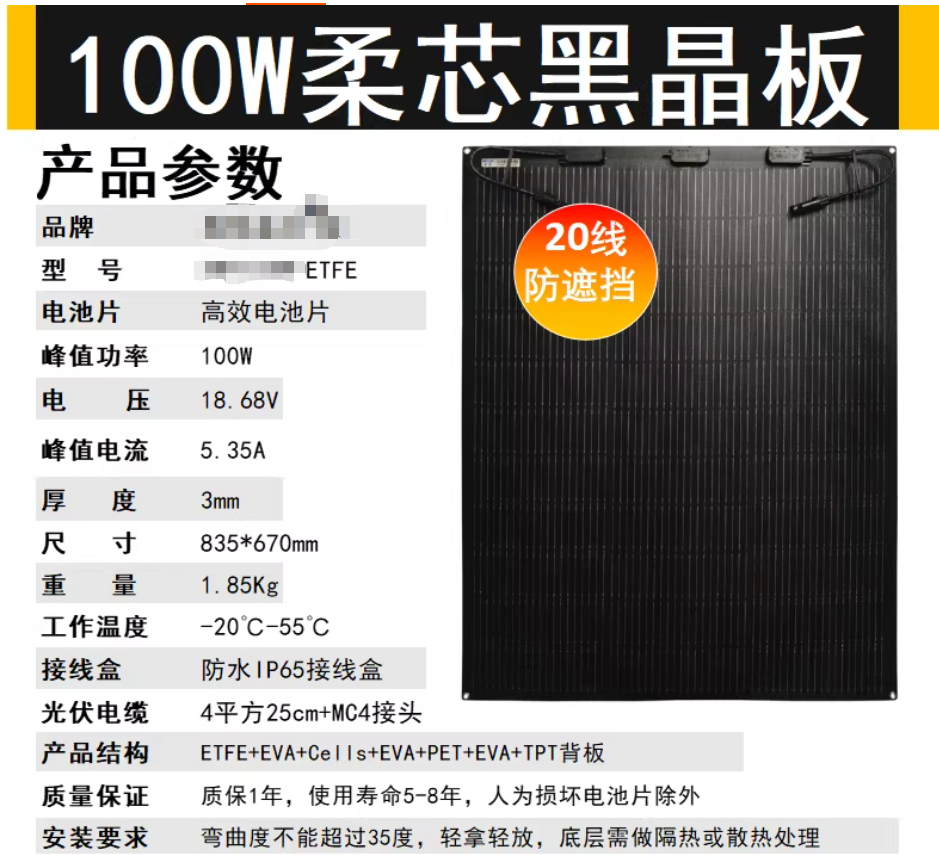
We can see that the module has a 7-layer structure: ETFE + EVA + Cells (power generation layer) + EVA + PET + EVA + TPT. Below we break down the role of each layer.
Layer Functions
ETFE Front Sheet
ETFE (ethylene-tetrafluoroethylene copolymer) serves as the flexible front sheet, replacing traditional glass. It offers high light transmittance (usually >94%), excellent weather resistance, UV resistance, and chemical corrosion resistance. It provides the outermost protection for the module while ensuring efficient light transmission.
EVA Encapsulation Film
EVA (ethylene-vinyl acetate copolymer) film is responsible for bonding and encapsulation. It firmly bonds the ETFE front sheet to the power generation layer, while blocking water vapor and oxygen, buffering stress, and protecting the cells.
Power Generation Layer (Cells)
The cells are the core power-generating component of the module. They carry out photoelectric conversion, turning the sunlight reaching the cells into electricity.
EVA (Second Layer)
This EVA layer again acts as encapsulation material, bonding the other side of the cells to the following layers. Its function is the same as the upper EVA.
PET Support Layer
PET usually works as a middle support layer or as the inner layer of the backsheet. In this flexible module it exists as the middle layer, providing mechanical strength, electrical insulation, and a certain level of water vapor barrier. However, its own UV and damp-heat aging resistance is limited, so it relies on outer-layer protection. Some flexible modules place the PET above the cell layer.
EVA Film (Bonding Layer)
This EVA film bonds the PET layer to the outer backsheet (TPT), ensuring tight inter-layer adhesion and preventing delamination.
Anti-Crack Film
The anti-crack film bonds the cells and prevents micro-cracks in the cells when the module is bent.
TPT Backsheet
The TPT backsheet is the outermost back layer of the module. Its structure is PVF (polyvinyl fluoride) film + PET substrate + PVF film, where PVF film is a polymer extruded from copolymers of fluorine and fluorocarbon molecules. The reason this structure is called a TPT backsheet is that the American DuPont company is a well-known producer of PVF film. DuPont's registered trademark for PVF film is Tedlar, abbreviated as "T" in backsheet structures, while "P" refers to the middle PET substrate.
The main roles of the TPT structure backsheet are: the outer fluorine film provides outstanding weather resistance, UV resistance, and environmental corrosion resistance; the middle PET layer provides mechanical support, electrical insulation, and the main water vapor barrier; the inner fluorine film has good adhesion with the EVA film, ensuring the backsheet bonds firmly with the encapsulation system.
Boosting Power Output
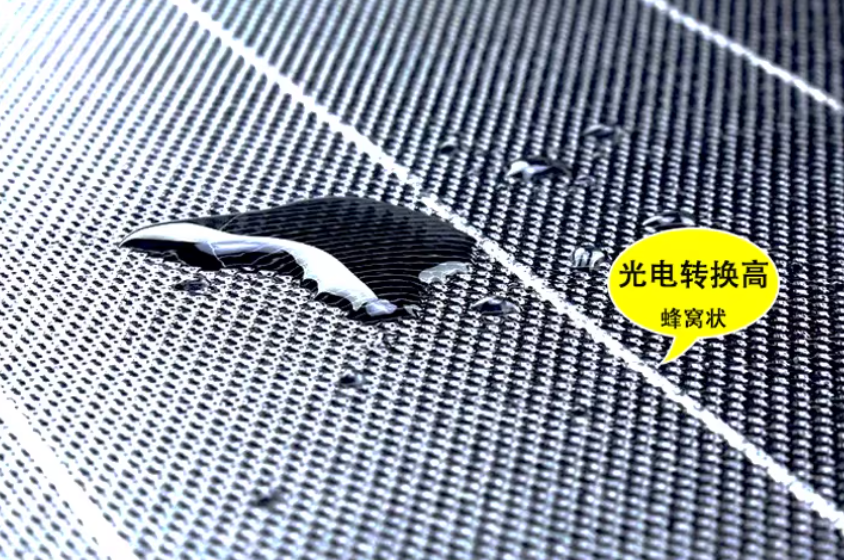
In addition, many flexible PV modules use a special process to create a honeycomb-shaped texture on the module surface in order to increase power generation. This honeycomb texture creates a certain "light trapping effect" that boosts the module's output.
Summary
Flexible PV modules use ETFE instead of glass as the front sheet, multiple layers of EVA for bonding and encapsulation protection, PET as the middle reinforcing layer, and TPT as the weather-resistant backsheet. Together they provide comprehensive physical protection, environmental sealing, and long-term reliability for the fragile power generation layer. At the same time, manufacturers create a honeycomb pattern on the module surface to improve power generation.
ooitech believes: semi-flexible PV modules wrap a delicate cell layer in a smart ETFE-EVA-PET-TPT sandwich to deliver lightweight, durable, and higher-yield solar power.
Further reading and background data
Public reference material on this topic, published by the organisations that maintain the industry's technology roadmap and market data: