Solar Panel Production Process: Lamination
Table of Contents
Solar Panel Production Process: Lamination
Today we are looking at one of the key processes in solar module manufacturing: lamination.
In a photovoltaic module production line, lamination is not just a heating step. It is one of the most important processes that decides the final performance, reliability, appearance, and service life of the finished solar panel. Through controlled temperature, vacuum, and pressure, the solar cells, glass, EVA or POE encapsulant, backsheet and other materials are bonded into a solid integrated module.
A good lamination process helps improve long-term power output and protects the module from moisture, mechanical stress, thermal cycling, and outdoor weather conditions. If the lamination is not well controlled, problems such as bubbles, poor adhesion, cell cracks, edge defects, or low encapsulant crosslinking may appear.
Working Principle of a Solar Module Laminator
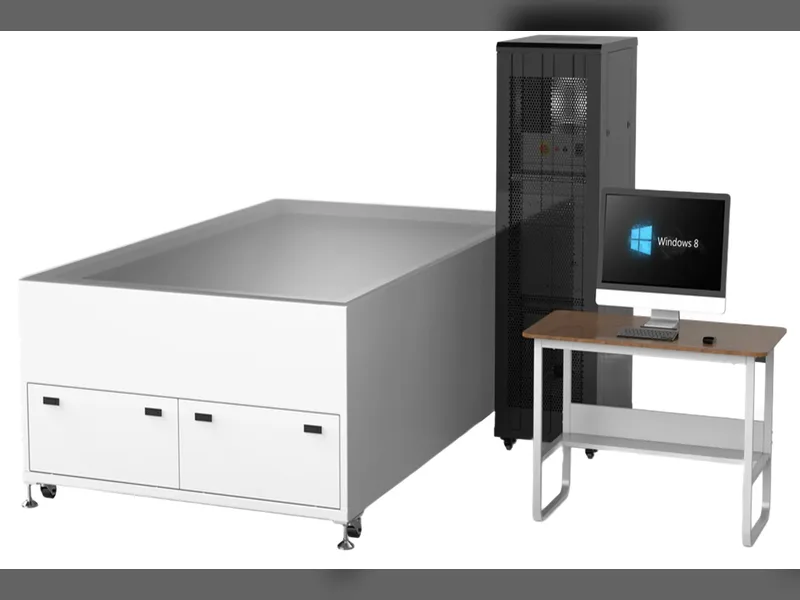
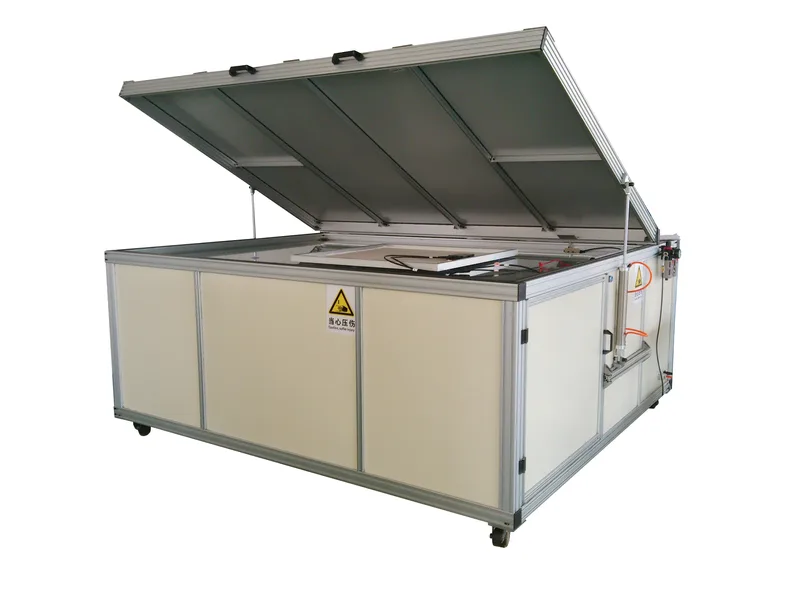
A typical solar panel laminator is mainly composed of the following parts:
| Main Part | Function |
|---|---|
| Bottom Plate / Heating Plate | A flat heating surface. It is usually heated by high-temperature oil or electric heating rods to reach the required process temperature. |
| Upper Cover | Equipped with a silicone membrane, sealing ring, and related components. It moves down to close the chamber and applies pressure through the membrane. |
| Upper Chamber | The space between the upper cover and the silicone membrane. |
| Lower Chamber | The space between the heating plate and the upper cover after closing. |
| Vacuum Pump | Used to evacuate the upper or lower chamber and remove air from the module stack. |
| Air Pump / Inflation System | Used to inflate the upper or lower chamber and apply pressure during lamination. |
After understanding these main parts, we can look at how the laminator works step by step.
Step 1: Closing the Cover
After the module enters the laminator, the upper cover moves downward under the force of hydraulic cylinders. When it reaches the correct position, the sealing ring on the upper cover contacts the bottom plate tightly, creating a sealed space. This sealed space is the lower chamber.
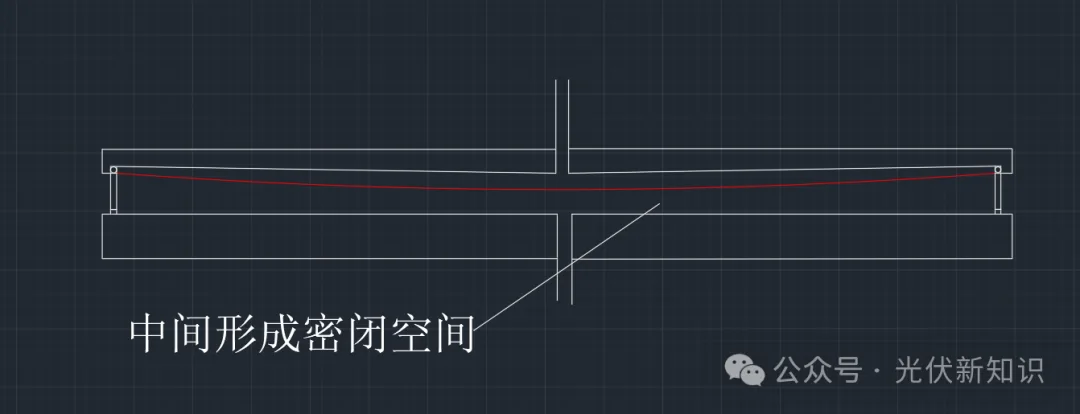
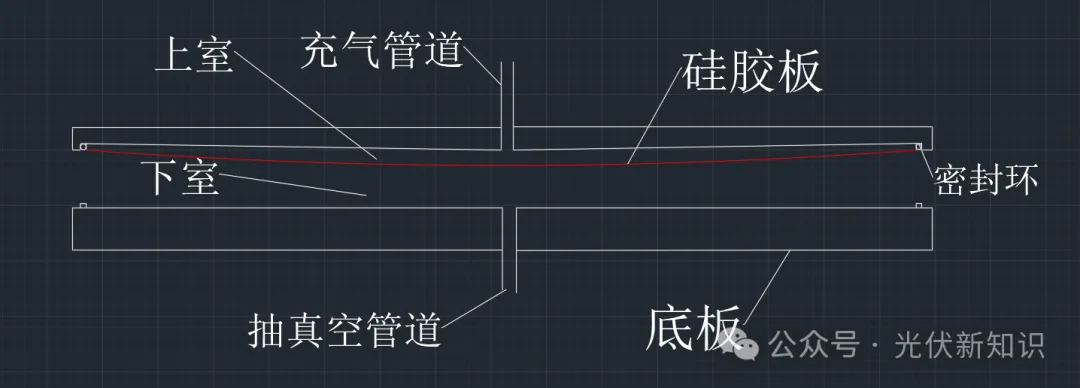
The drawing may look simple, but it helps explain the basic structure clearly.
Step 2: Vacuuming the Lower Chamber
The vacuum pump starts to evacuate the chamber. In many production settings, the vacuuming process lasts around 6 minutes, although the exact time depends on module type, encapsulant material, laminator design, and process recipe.
During vacuuming, the bottom plate is already heated. Once the module enters the laminator, it is continuously heated until it approaches the set temperature of the heating plate. In this heating stage, the encapsulant film starts to melt, changing from solid state to flowing state.
The vacuum environment allows air and volatile gases inside the melted encapsulant and module stack to escape. This is very important. If the trapped gas is not removed before the encapsulant starts curing, bubbles may remain inside the module after lamination.
Step 3: Upper Chamber Inflation and Lamination Pressure
After vacuuming, the upper chamber is inflated. The silicone membrane is a flexible material, so it expands and deforms under air pressure. It then presses tightly against the module surface and applies uniform pressure.
This pressure helps force remaining bubbles out of the module. At the same time, the combination of heat and pressure makes the flowing encapsulant begin to cure and crosslink. The encapsulant gradually changes from liquid-like state into a stable solid bonding layer.
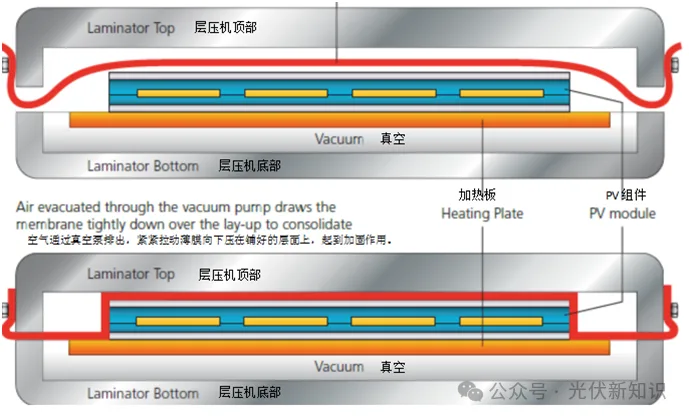
This schematic shows that after inflation, the silicone membrane fits tightly onto the module. It also helps prevent the melted encapsulant from being squeezed out excessively under pressure.
Step 4: Pressure Holding and Curing
When the upper chamber reaches the required pressure, the laminator keeps this pressure for a certain period of time. During this holding period, the encapsulant continues crosslinking until the required crosslinking degree is achieved.
After the process is completed, the lower chamber is inflated to release the vacuum state. At the same time, the upper chamber is evacuated to release pressure. Then the upper cover separates from the bottom plate, and the module moves to the cooling chamber before unloading.
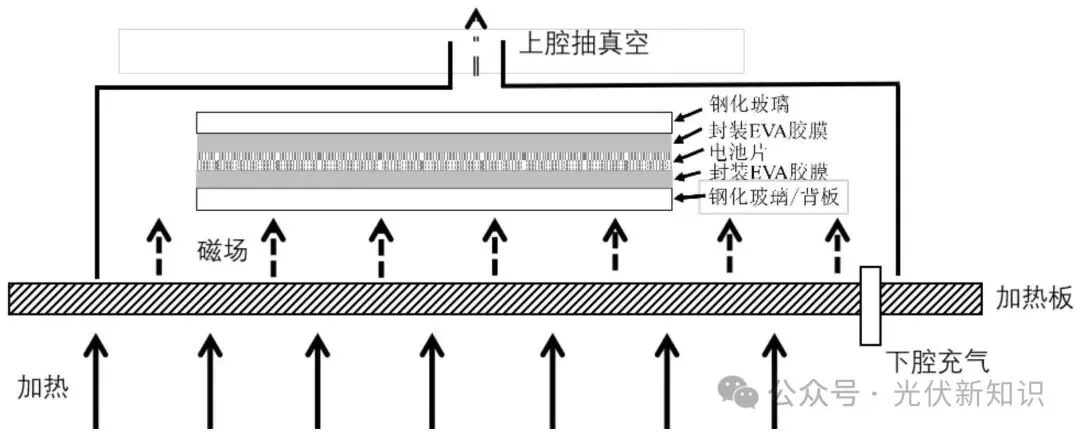
This schematic from a website gives a general idea of the process flow.
Important Process Notes
Non-Stick Cloth Is Required
The module does not directly contact the silicone membrane or the heating plate. A layer of non-stick cloth is placed between them. Its main function is to prevent melted EVA or other encapsulant from sticking to the heating plate or silicone membrane.
Modern Laminators Usually Use Three Working Chambers
Most modern PV module laminators are designed with three working chambers, and each chamber has a different process purpose.
| Stage | Main Purpose | Typical Process Feature |
|---|---|---|
| First Stage | Melt encapsulant and remove air bubbles | Lower temperature, vacuum, and smaller pressure. Usually around 120°C depending on material and recipe. |
| Second Stage | Encapsulant crosslinking and final bonding | Higher temperature and higher pressure. Usually around 140°C depending on material and recipe. |
| Third Stage | Cooling and shape stabilization | Vacuum, very small pressure, and low plate temperature around 20°C to cool the module. |
The reason for using three stages is mainly to improve production efficiency and process stability.
In the first stage, the main target is to melt the encapsulant and remove air bubbles. The temperature should not be too high, and the pressure should not be too large. If the encapsulant starts crosslinking too early, internal bubbles may not escape properly, and bubbles will remain inside the finished module.
In the second stage, the main target is crosslinking. The temperature is higher and the pressure is greater, which helps accelerate the encapsulant curing reaction and improve bonding performance.
In the third stage, cooling is the main task. Only a small pressure is needed to reduce deformation or bending during cooling.
Common Abnormalities in the Lamination Process
| Defect | Possible Causes |
|---|---|
| Bubbles on the solar cell surface | First-stage temperature too high, encapsulant crosslinking before bubbles escape, abnormal vacuum condition, insufficient vacuum speed, or vacuum time too short. |
| Snowflake-like bubbles at edges or four corners | Laminating frame height may be unsuitable, or the frame size may not match the module properly. |
| Peel strength or crosslinking degree not qualified | Temperature too low, pressure too small, holding time too short, or encapsulant quality issue. |
| Cell cracks after lamination | Lamination pressure too high, foreign objects on high-temperature cloth, or uneven cloth surface. |
| Bubbles around ribbon area | Flux quality issue, flux not fully dried, or soldering-related residue problems. |
For stable module quality, lamination recipes should not be copied blindly from one product to another. Different glass thickness, cell technology, encapsulant type, module size, backsheet structure, and production speed may all require recipe adjustment.
Ooitech's View
As an equipment supplier, we see it this way: lamination is often where small process deviations become visible quality problems, so factories should treat the laminator recipe as a controlled production parameter, not just a machine setting. For high-efficiency modules such as MBB, TOPCon, IBC, or shingled products, uniform pressure, stable vacuum performance, and correct heating zones are especially important because the cell structure and interconnection design can be more sensitive to stress. Ooitech believes a good module line is not only about buying equipment, but also about matching process training, material behavior, and daily maintenance into one stable production system.